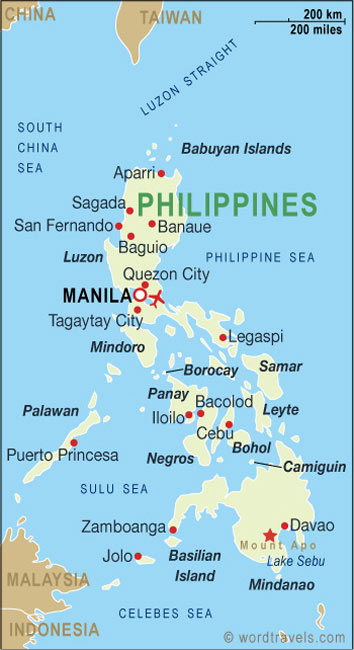
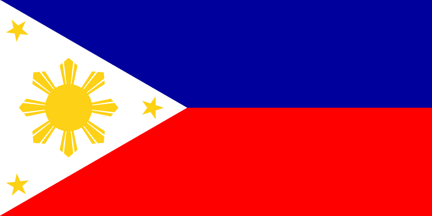
Just thought I'd share this nice feature from CNN.com. Certainly Filipinos have suffered more than their fare share of natural and man made disasters in 2010, but this article focuses on hope for the future.
Despite disasters, Filipinos upbeat, survey shows
read more...
Monday, February 8, 2010

Friday, February 5, 2010
Jeepneys

Very Colorful Public Transportation of the Philippines
(I hope we get to ride in one!)
I found the sites below describe them best:
"When American troops began to leave the Philippines at the end of World War II, hundreds of surplus jeeps were sold or given to local Filipinos. The Filipinos stripped down the jeeps to accommodate several passengers, added metal roofs for shade, and decorated the vehicles with vibrant colors and bright chrome hood ornaments.
The jeepney rapidly emerged as a popular and creative way to re-establish inexpensive public transportation, which had been virtually destroyed during World War II. Recognizing the widespread use of these vehicles, the Philippine government began to place restrictions on their use. Drivers now must have specialized licenses, regular routes, and reasonably fixed fares."
Source: http://en.wikipedia.org/wiki/Jeepney
"The undisputed King of the Philippine Roads is the jeepney. Since it first emerged after the Japanese occupation of the Philippines, it has become a fixture in roads all over the country so much so that it is now considered a symbol of national pride. Jeepneys are adorned with colorful designs that distinguish them from one another, with themes ranging from the serious to the outright silly, but all uniquely Filipino."
Source: Republic of Philippines Department of Tourism
Newer versions of the Jeepney are not repurposed vehicles and include air conditioning. Electrical Jeepneys are also hitting the streets of the Philippines. Read more...
Photo above courtesy of http://www.traveladventures.org/
Jollibee!

Jollibee is the McDonalds/KFC of the Philippines. The Jollibee mascot appears to be very popular with children! Jollibee restaurants can be found in several other countries. In the U.S., check out Jolibee's in California, Nevada and New York.
The menu consists of burgers, hot dogs and chicken, as well as noodle and rice dishes.I don't think I'll be able to find much here (or at McDonalds) that is in sync with my new healthier eating plan. But I may have to try the Chickenjoy. According to the website, it's both "Crispylicious" and "Juicylicious". Who could resist?
Filipino Language
I've been trying to learn a few words in Tagalog (Ta-GA-Lug), which is the basis for Filipino, one of the 2 official languages of the Philippines. Thanks to translation books we received for Christmas and birthday presents, and with the help of a few Filipino colleagues and You Tube, I've been attempting to practice a bit.
While English is the other offical language, given the age we except for our child (0-36 months at referral) and depending on the Child Care Agency or Foster setting, he/she may not have been exposed to much English but may know a litte Tagalog. If our child lives on an island that speaks a different dialect, we'll at least have a few basics for our travel while in Manila.
We hope to learn a few basic words to help express our gratitude to our child's care givers and others who will be helping us while we are in the Philippines. A few words to start...
Please - the prefix Paki is attached to other words, so this varies
Thank you - Salamat po
Hello - Kamusta (Ka-MOO-Sta)
Mom - Nanay, Nanang or Ina (mother)
Dad - Tatay
Sister - Ate (used for older sister)
Younger Brother or Sister - Kapatid
Magandang araw! - Beautiful day!
Mahal kita - I love you
As with the English language, there are many different ways to express the above. Some videos for your viewing pleasure, no tests, I promise!
Videos
Teach Your Kids to Count 1-10 in Tagalog/Filipino
Learning Tagalgo - Basic Phrases
Wikipedia on Tagalog: http://en.wikipedia.org/wiki/Tagalog_language
Some of the many dialects can be found at: http://www.seasite.niu.edu/Tagalog/languages_and_dialects_in_the_ph.htm
While English is the other offical language, given the age we except for our child (0-36 months at referral) and depending on the Child Care Agency or Foster setting, he/she may not have been exposed to much English but may know a litte Tagalog. If our child lives on an island that speaks a different dialect, we'll at least have a few basics for our travel while in Manila.
We hope to learn a few basic words to help express our gratitude to our child's care givers and others who will be helping us while we are in the Philippines. A few words to start...
Please - the prefix Paki is attached to other words, so this varies
Thank you - Salamat po
Hello - Kamusta (Ka-MOO-Sta)
Mom - Nanay, Nanang or Ina (mother)
Dad - Tatay
Sister - Ate (used for older sister)
Younger Brother or Sister - Kapatid
Magandang araw! - Beautiful day!
Mahal kita - I love you
As with the English language, there are many different ways to express the above. Some videos for your viewing pleasure, no tests, I promise!
Videos
Teach Your Kids to Count 1-10 in Tagalog/Filipino
Learning Tagalgo - Basic Phrases
Wikipedia on Tagalog: http://en.wikipedia.org/wiki/Tagalog_language
Some of the many dialects can be found at: http://www.seasite.niu.edu/Tagalog/languages_and_dialects_in_the_ph.htm
Subscribe to:
Posts (Atom)